A wholesale sell sheet is arguably the most important document in a food business owner's toolkit when they transition from selling directly to consumers to working with retailers, cafes, or distributors.
It's not just a menu—it's your one-page salesperson. A polished sell sheet makes it easy for buyers to say "yes" by giving them all the crucial information they need to calculate their profits, manage their inventory, and place an order.
For our partners here at the commissary, mastering this tool is the key to unlocking major growth.
1. Why a Sell Sheet is Your Secret Weapon
Imagine a busy grocery store buyer or cafe owner. They receive dozens of pitches weekly. They won't read an entire catalog. They need key data at a glance.
- Clarity: It eliminates guesswork about pricing, sizes, and case packs.
- Professionalism: It shows you are organized and ready for wholesale business.
- Speed: It speeds up the ordering process, which means faster revenue for you.
2. The Anatomy of a High-Impact Sell Sheet
Your sell sheet must be clean, branded, and contain five essential components. Think of these as required fields for closing the sale:
Component 1: The Header and Brand Identity
This is your first impression. Make it count.
- Your Logo & Brand Name: Prominent and professional.
- High-Quality Photography: Feature one or two irresistible shots of your best-selling or most visually appealing product (e.g., a perfectly glazed cinnamon roll or a stack of cookies).
- Contact Info (Top Corner): Include your name, phone number, email, and website/ordering portal URL.
- Brief Mission/Tagline: A quick line explaining your unique selling proposition (e.g., "Artisan Breads, Made with Local Grains").
Component 2: Product & Pricing Table (The Core)
This section must be organized into a clean table format. The buyer relies on this data for their inventory and financial planning.
| Column | Purpose | Example for Baked Goods |
|---|---|---|
| SKU / Item Name | Clear identifier for easy ordering. | Cinnamon Roll (Classic), Sourdough Loaf (Small) |
| Case Pack | How many units are in one case/box. | 6 units/case, 12 units/box |
| Unit Size | Weight or dimensions of the individual item. | 4 oz, 10-inch diameter |
| Wholesale Price (WSP) | The price the retailer pays you per unit. | $4.50 |
| Suggested Retail Price (SRP) | The price you recommend they sell it for. | $8.99 |
| Shelf Life & Storage | Essential for inventory management. | 7 days (room temp), Frozen (6 months) |
Pro Tip: Make sure your WSP allows the retailer a minimum 40–50% profit margin based on your SRP. This is the industry standard and makes your product attractive.
Component 3: Key Selling Points (The Pitch)
Retailers want products that resonate with their customers. Use bullet points to highlight the unique benefits of your items:
- Dietary Claims: Vegan, Gluten-Free, Nut-Free, etc.
- Ingredient Differentiators: Made with organic flour, Local fruit, Fair Trade chocolate.
- Awards or Press: "Voted Best Croissant 2024," "Featured in Local Food Magazine."
- Consumer Benefits: "High-profit margin item," "Great for grab-and-go displays."
Component 4: Logistics & Ordering
Prevent bottlenecks and confusion by clearly outlining the business rules.
- Minimum Order Quantity (MOQ): Set a reasonable minimum dollar amount or case count to make delivery cost-effective for you.
- Delivery/Pickup Schedule: "Delivery available Mon/Wed/Fri in the metro area" or "Order cut-off is 2 PM for next-day delivery."
- Payment Terms: Common terms are Net 30 (payment due 30 days after delivery) or COD (Cash on Delivery).
- Lead Time: How far in advance must they order? (e.g., 48 hours for breads, 72 hours for custom cakes).
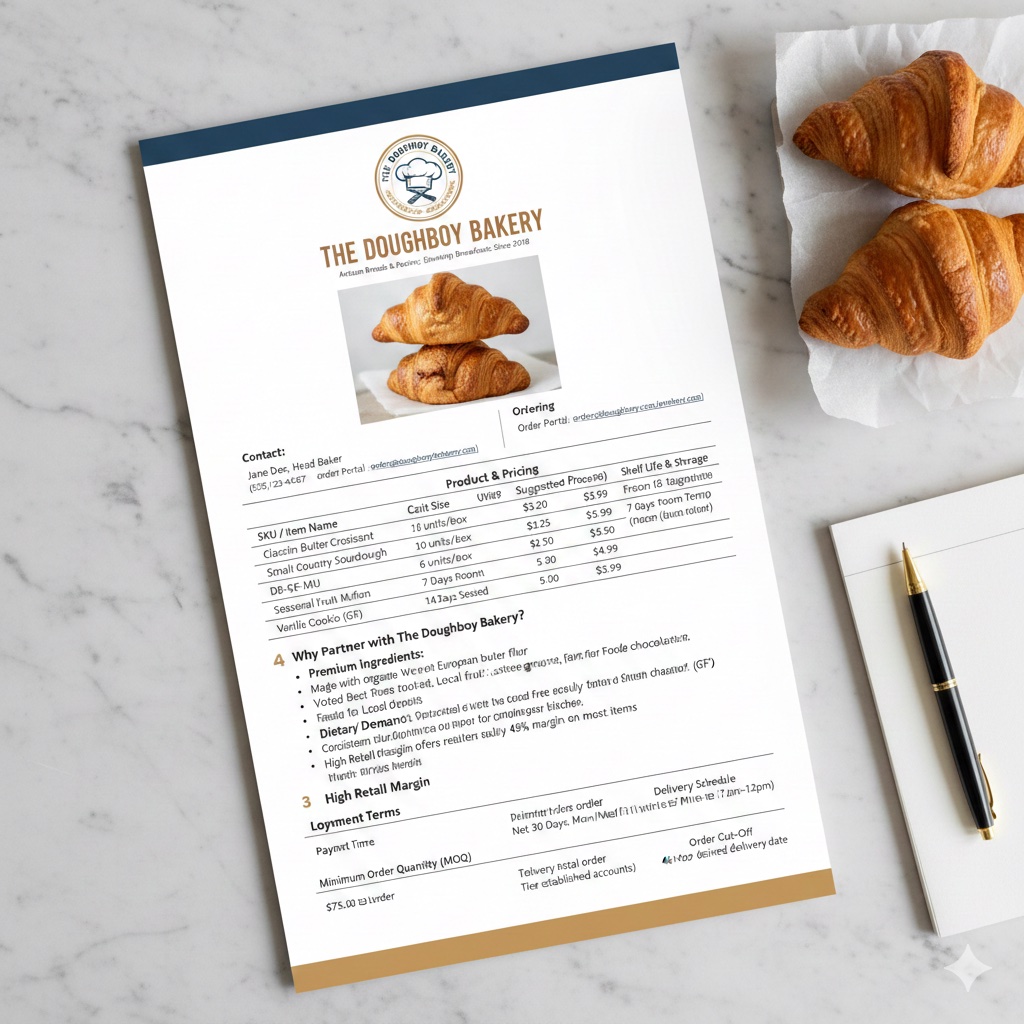
3. Full Sell Sheet Example: "The Doughboy Bakery"
This example demonstrates how all the components come together on a professional, single page.
THE DOUGHBOY BAKERY
Artisan Breads & Pastries: Elevating Breakfasts Since 2018
Contact: Jane Doe, Head Baker | (555) 123-4567
Ordering: Email orders to: orders@doughboybakery.com | Order Portal: doughboybakery.com/wholesale
PRODUCT & PRICING TABLE
| SKU | Item Name | Unit Size | Case Pack | WSP (per unit) | SRP (Suggested) | Shelf Life/Storage |
|---|---|---|---|---|---|---|
| DB-CR-CL | Classic Butter Croissant | 4.5 oz | 10 units/box | $3.25 | $5.99 | 3 Days Room Temp (Best Day 1) |
| DB-SD-SM | Small Country Sourdough | 16 oz | 6 units/box | $4.50 | $8.50 | 7 Days Room Temp |
| DB-SF-MU | Seasonal Fruit Muffin | 5 oz | 12 units/box | $2.50 | $4.50 | 5 Days Room Temp |
| DB-VC-GF | Vanilla Cookie (GF) | 3 oz | 8 units/box | $2.00 | $3.99 | 14 Days Sealed |
Why Partner with The Doughboy Bakery?
- Premium Ingredients: We use only European butter and locally-sourced stone-ground flour.
- Dietary Demand: Our Vanilla Cookies are certified Gluten-Free (GF), meeting high customer demand.
- Consistency Guaranteed: Products are baked fresh daily in our professional commissary kitchen.
- High Retail Margin: Our WSP/SRP offers retailers a healthy 45% margin on most items.
LOGISTICS & ORDERING TERMS
| Minimum Order Quantity (MOQ) | Payment Terms | Delivery Schedule | Order Cut-Off |
|---|---|---|---|
| $75.00 total order | Net 30 Days (for established accounts) | Tuesday & Friday (7am-12pm) | 48 hours prior to desired delivery date |
4. Conclusion: Get Pitching!
Your sell sheet is your silent business partner. Take the time to make it look professional, check all your pricing calculations (twice!), and ensure your high-resolution photos are ready. Once perfected, this document will be the foundation for every new wholesale account you win.
Now that you know the structure, it's time to compile your product details and get started!